1/1


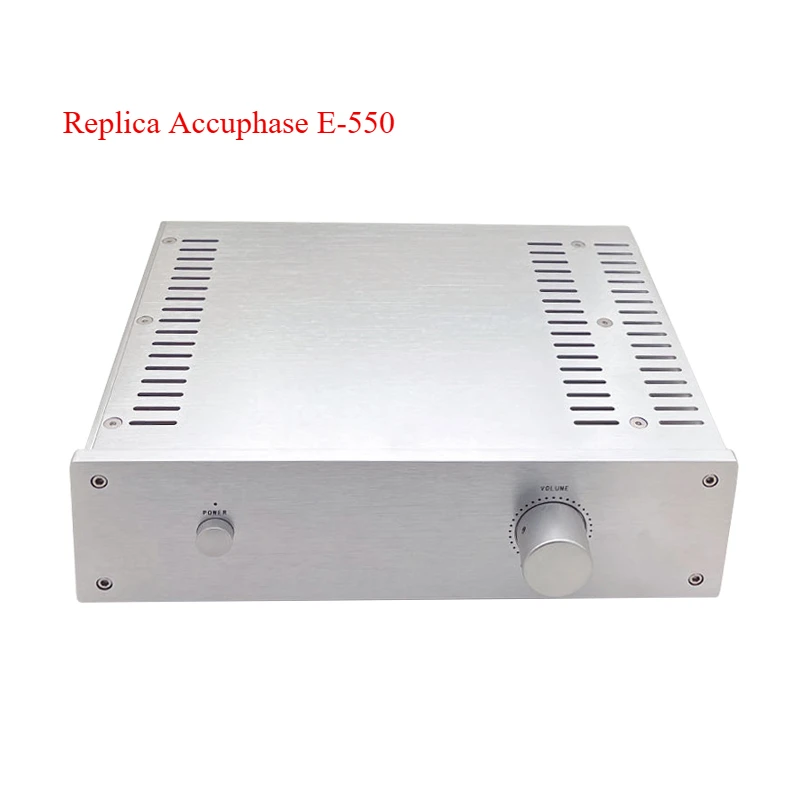
Replica Accuphase E-550 Pure Class A FET Power Amplifier Audiophile Hi-Fi Amp
(0 Reviews)
$154.88
1/1


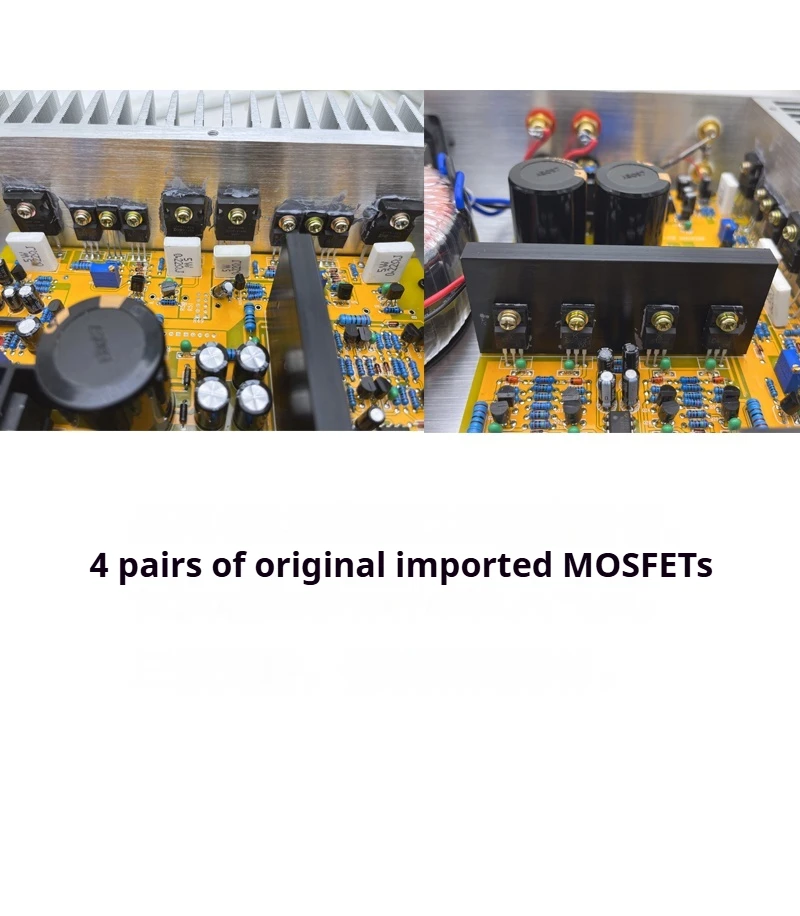
FET amplifiers are widely recognized in the audio industry for having a sound signature that closely resembles that of tube amplifiers.
High Input Impedance & Easy to Drive: They have a high input impedance, making them easy to drive. This impedance also remains relatively stable across the entire frequency spectrum.
Low Input Capacitance: The low input junction capacitance (also known as Miller capacitance) ensures that changes in the output load have minimal impact on the input stage.
High Power Supply Efficiency: They make more efficient use of the power supply compared to other designs.
Strong Load-Driving Capability: They possess an excellent ability to drive demanding and difficult speaker loads.
Optimized Layout & High Fidelity: With a rational and optimized PCB layout, the amplifier exhibits high stability and an excellent signal-to-noise ratio, resulting in an outstanding reproduction of musical details.
Superior Stability & Low Noise: FETs offer better thermal stability, resistance to radiation, and lower intrinsic noise characteristics.
High Slew Rate: A high slew rate contributes to excellent high-frequency performance and transient response.
Musical, Even-Order Harmonics: The distortion produced by FETs is predominantly even-order harmonics. This type of distortion is widely considered to be more musical and pleasing to the human ear.
Superb Soundstage & Tonality: The amplifier delivers a well-balanced energy across the low, mid, and high frequencies. The sound has density and weight, with deep, extended bass and a stable soundstage. It offers excellent transparency, layering, resolution, and imaging, with a superb ability to render a three-dimensional acoustic space.
Unique Transfer Characteristic: FETs have a square-law transfer characteristic (where the output is a second-power function of the input). Their distortion is generally lower than Bipolar Junction Transistors (BJTs) but can be slightly higher than vacuum tubes.
Solid-State Physics: As solid-state devices, electron transport occurs within a crystal lattice. Irregularities within this lattice can be a source of intrinsic device noise, such as flicker noise (1/f noise).